Text-Based Life Simulator
A text-based life simulator is a game that runs a whole life — birth, school, jobs, money, relationships, death — through text and choices rather than a 3D world. The screen shows numbers and sentences; you press buttons. It is one of the oldest forms of browser game and still one of the most played, because the format does something graphics cannot: it makes the consequences of a decision visible within a second.
This page explains what the category actually contains, what the good ones do that the bad ones do not — and where MY LIFE sits in it. Being straight about that last part: MY LIFE is not a pure text game. It is a hybrid, and the section further down explains exactly what that means and when you would rather have the pure version.
"Text-based" covers three different things
The label is used loosely, and the difference matters if you are choosing something to play tonight.
| Type | What you do | Typical examples | Session length |
|---|---|---|---|
| Pure text life sim | Press buttons through a life: age up, choose a school, take a job, spend money. Almost no prose — the interface is the game | BitLife and its many imitators; the older Android classic InstLife, which is no longer maintained | 5–30 minutes, often in bed |
| Choice-based interactive fiction | Read a scene, pick one of three or four options, live with the branch | Choice of Games and Hosted Games titles, playable in a browser or an app | 1–4 hours, like a short novel |
| Persistent text world | Grind actions and stats inside a shared text world that keeps running without you | Fallen London is the long-running reference point | Minutes a day, for years |
If you searched for "text-based life simulator" and wanted the first row, the honest answer is that the pure form has almost entirely moved to mobile. The browser versions that still exist are mostly the second and third rows — interactive fiction and persistent worlds — plus hybrids like this site's game.
Why the format works
Every number is visible. Cash, salary, health, happiness, stress: they sit on the screen and change when you act. A 3D game has to animate a consequence; a text game just rewrites a line, and you feel the cause and effect immediately.
Decisions are cheap to make and expensive to live with. The genre's whole trick is a decision that costs nothing at the moment of pressing and everything thirty in-game days later. Take the loan, skip the study, buy the car — the penalty arrives as a monthly deduction you did not budget for.
It fits in the gaps of a real day. No install, no loading, no controller. A text sim is the only game genre that genuinely works in a browser tab next to your email.
It removes the graphics budget from the equation. A small team can ship a text sim that plays better than a 3D one, which is why the category keeps producing odd, specific, ambitious games.
Where the format breaks
Reading fatigue is real: after forty screens of the same layout, players stop reading and start tapping the first option. The cure is to change the shape of the screen — a table, a card, a different colour for a bad outcome — not to write more prose.
The second failure is no sense of place. A text life sim can tell you that you moved to a cheaper apartment. It cannot make you feel the neighbourhood, which means the decisions stay abstract. Games that try to fix this usually add a map; games that do not, stay abstract and rely on the arithmetic being interesting enough on its own.
Where MY LIFE sits — the hybrid
MY LIFE keeps the text sim's ledger and adds a walkable Manhattan. The numbers are still text: a right-hand panel with cash, salary, monthly cash flow, stress and health. What is different is that you do not press "age up" — you spin a wheel, walk one to six blocks, and land on a building, and that building is the choice. The New York map is the menu.
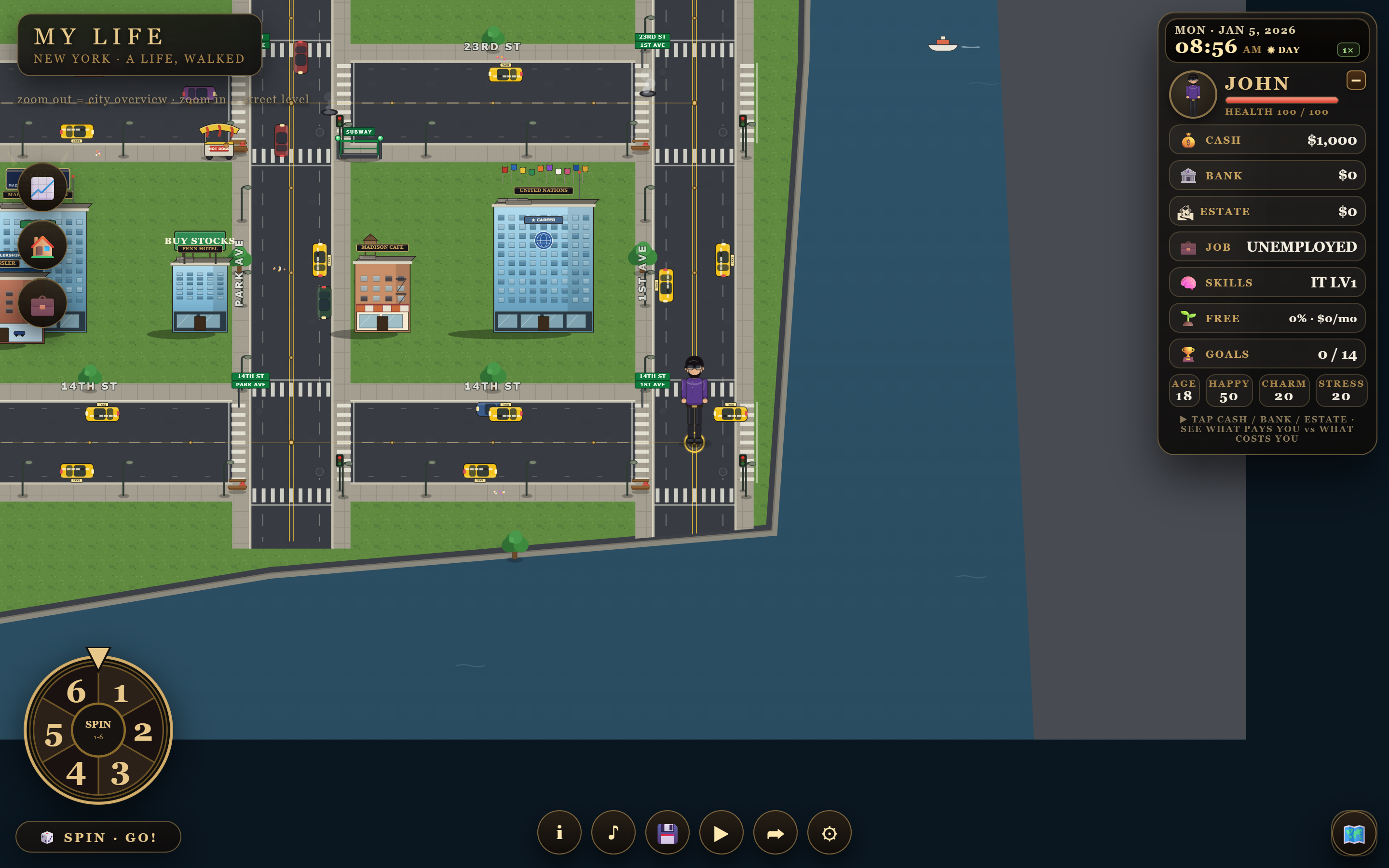
| Pure text life sim | MY LIFE (hybrid) | |
|---|---|---|
| Input | Buttons and menus | Spin the wheel, walk, land on a building |
| Where the numbers live | The whole screen | One side panel, always visible |
| Time | You age up when you press | A day passes on its own; a month settles every 30 days |
| Cost | Free with ads, or paid | Free, no ads in the game, no account |
| Install | Usually an app | Browser only |
| Save | Usually cloud, tied to an account | Autosaves every walk and new day into your own browser, plus a 💾 instant-save button — nothing uploads |
| Best for | Reading a life in fast-forward | Feeling a month of bills arrive |
The trade-off is honest in both directions. You get a place and a pace; you lose the instant, frictionless "age up" that makes a pure text sim so easy to play in bed. If the appeal was tapping through thirty years in ten minutes, a hybrid is not a better version of that — it is a slower, more spatial game with the same ledger underneath.
If you specifically want pure text tonight
Go to the app stores and search the first row of the table above; that is where the genre lives now, and the good ones are cheap or free. In a browser, the strongest option is choice-based interactive fiction from Choice of Games — their catalogue runs from fantasy to corporate drama and every title is a branching novel rather than a stat grind. Fallen London remains the best example of a persistent text world, and it is free to start.
What no pure text game gives you is the thing this site was built to test: whether a monthly cash-flow statement is more legible when you have to walk to the bank. That is the whole experiment, and it is free to try — one life takes a few minutes.
What carries over from the genre
Three habits from text sims are built into MY LIFE on purpose. Stat visibility: the ledger never hides, including when it is embarrassing. Delayed consequence: a 15% consumption loan is cheap on the day you take it and expensive every month afterwards. And a legible ending: when the fifteenth of the 19 goals is banked, the game prints a closing card instead of a score. Text sims have always been better at endings than 3D games, because a sentence can be final in a way a cutscene rarely is.
PLAY MY LIFE — FREE, NO INSTALLFrequently asked
Is MY LIFE a text-based life simulator? Yes. MY LIFE tells a whole life — birth, school, jobs, money, health and the end — through words, numbers and a simple city map rather than 3D graphics. The decisions are the game; the text is what makes them land.
Do I have to read a lot to play? No. Each turn is a short prompt with a few choices you tap or click. The writing is there to give the numbers a story, not to make you read a book.
Can I play it on a phone? Yes — it runs in any mobile browser with no install. The city map is easier to read on a laptop or tablet, but the game itself works on a phone.